Vulnerability Management.
Thirteen scan engines, one queue, ranked by what attackers are using.
Scanners give you noise. opsnite gives you a queue. Thirteen engines run from one scan plan, a finding two engines agree on becomes one finding, and every finding carries its EPSS exploit probability and CISA KEV status, so the queue sorts by what attackers are actually using.
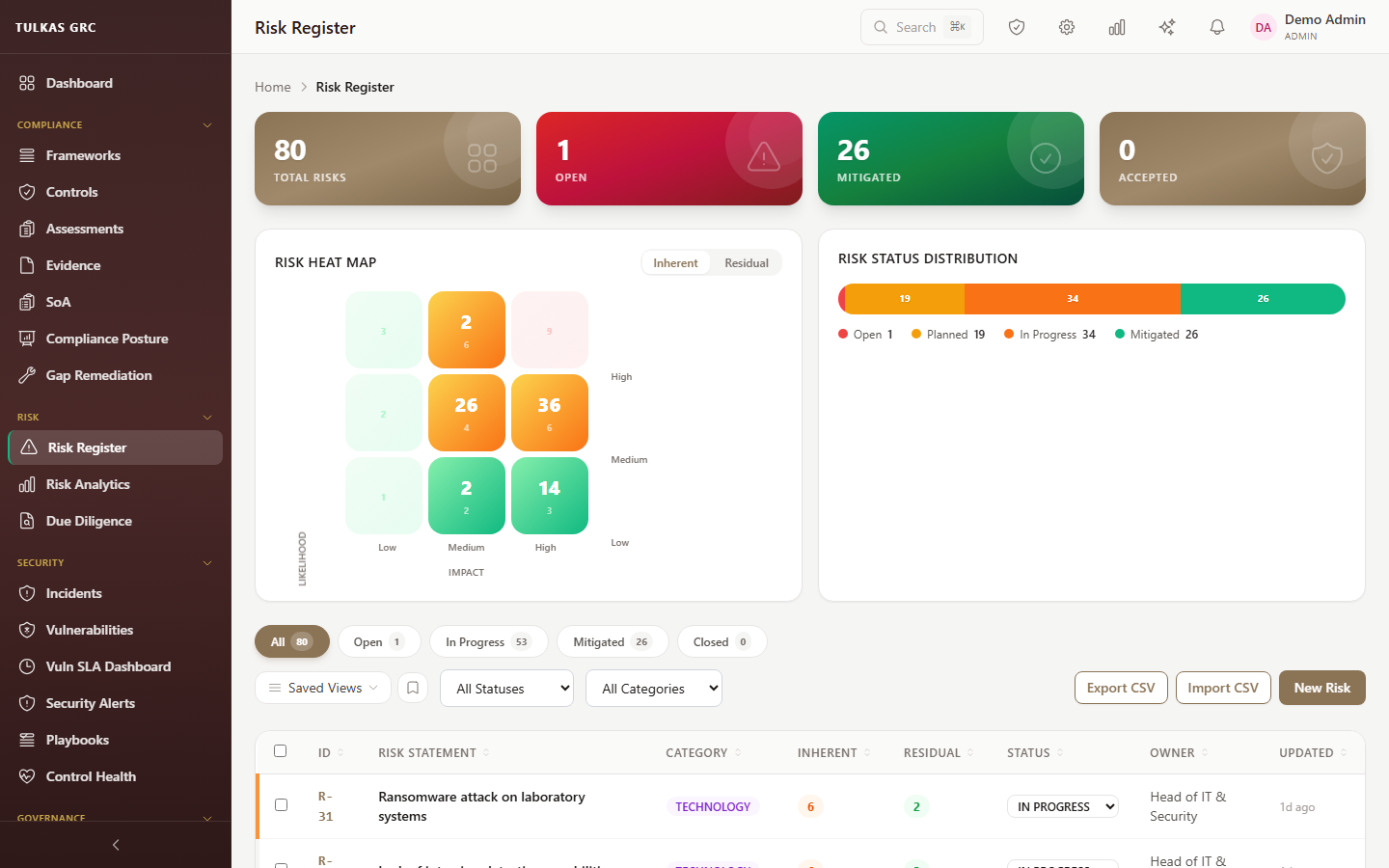
Risk register linked to findings, demo tenant (sample data).
What it does today.
Thirteen engines, one dispatch
nuclei, trivy, prowler, nmap, openscap, lynis, zap, nikto and kube-bench run end to end. The OpenVAS, Wazuh, BloodHound and Falco adapters are built and need a service you run. Each scan runs as its own isolated container task, up to 10 at a time per tenant.
Plans, not guesswork
Pick a policy (KEV-only, critical-only, CIS, by tag, or custom) and the planner resolves the exact detectors from a catalog of 14,264. KEV-only resolves to 479 detectors. Critical-only resolves to 1,856.
Correlation across engines
The same issue found by two engines on one asset becomes one finding with both sources shown. Assets merge across engines behind a confidence gate.
Findings that know what they touch
Each finding carries the controls and framework requirements it puts at risk. Microsoft Defender and AWS Security Hub findings land in the same queue. The Tenable, Qualys and Rapid7 connectors are built and switch on with credentials.
What you get out of it.
- One queue instead of an inbox per scanner
- Ranked by EPSS and CISA KEV, not CVSS alone
- Findings that show which controls they put at risk
- Validation run: 9 engines pass, 0 fail, 4 need a service you run
Every name here is in the product. “(built)” means the connector switches on with your credentials but hasn’t run against a live customer system yet.
Stronger together.
Modules share one schema, so each one reads the others’ records. Three that pair naturally with this one.
See Vuln Mgmt with your own questions.
Send us what you need it to answer and we’ll walk you through the module on our demo tenant.